
Desserts
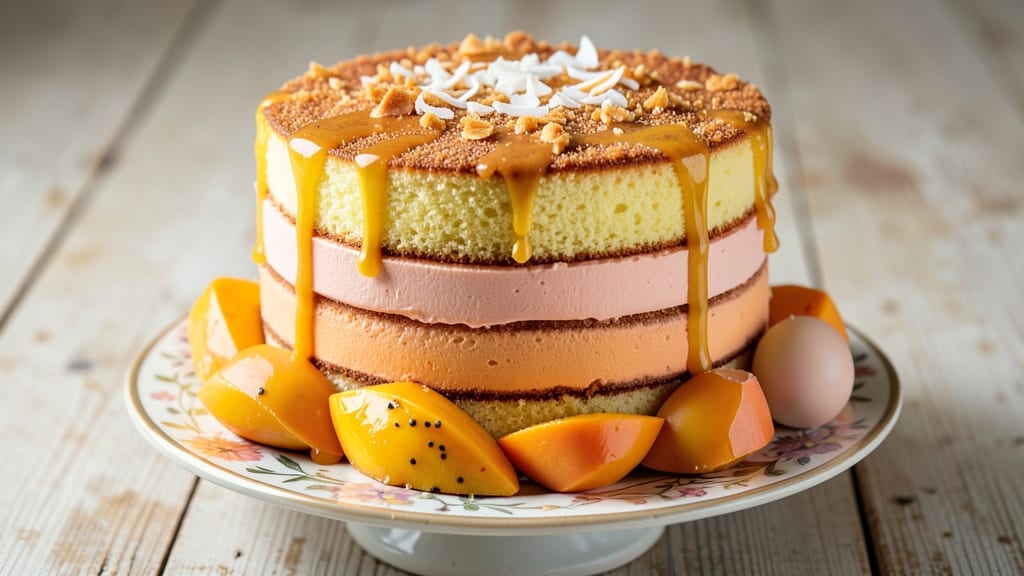
This Asian mango cake recipe transforms ripe mangoes into layers of velvety sponge and silky filling that taste like summer in every bite. 🌺 The secret lies in blending mango purée with eggs and butter to create a moist, fragrant cake that balances sweetness with subtle tropical notes.
I've perfected this version to stay tender yet sturdy enough for clean slices—no dry crumbs here.
The magic happens in the layers: a delicate vanilla-infused sponge alternates with mango filling that's thick enough to hold its shape but light enough to melt in your mouth.
A touch of lime zest brightens the flavors, while toasted coconut flakes on top add crunch. This recipe delivers restaurant-quality results with simple techniques—no fancy equipment required.
What you'll end up with is a cake that's as beautiful as it is delicious, with golden layers revealing creamy mango filling when sliced. The aroma alone will have everyone gathering around your kitchen, and each bite delivers that perfect balance of sweet, tangy, and tropical.
Perfect for celebrations or when you want to impress with a dessert that feels special yet approachable.
Serve at room temperature with a dollop of whipped cream or a scoop of vanilla ice cream to enhance the tropical experience. The cake keeps well for 3 days covered at room temperature or can be frozen for up to 2 months. Here's how to create this tropical masterpiece!
Ingredients for asian mango cake
Tropical flavors and simple pantry staples create this dreamy mango cake.
| Ingredient | Amount | Notes |
|---|---|---|
| Ripe Mangoes 🍈 | 3 cups | Peeled, puréed, no seeds |
| All-Purpose Flour 🌾 | 2 ½ cups | Sifted, spooned lightly |
| Granulated Sugar 🍚 | 2 cups | Superfine preferred for smoothness |
| Unsalted Butter 🧈 | 1 ½ cups | Room temperature, softened |
| Large Eggs 🥚 | 6 whole | Room temperature, separated |
| Vanilla Extract 🌿 | 2 tsp | Pure vanilla preferred |
| Baking Powder 🧂 | 2 tsp | Diamond Crystal preferred |
| Salt 🧂 | ½ tsp | Fine sea salt preferred |
| Lime Zest 🍋 | 1 tbsp | Freshly grated, organic preferred |
| Toasted Coconut Flakes 🥥 | ½ cup | Unsweetened, lightly toasted |
| Heavy Cream 🥛 | 1 cup | Cold, for whipped topping |
| Powdered Sugar 🍚 | ½ cup | For whipped cream topping |
| Cornstarch 🌾 | 1 tbsp | For mango filling thickness |
The mangoes are everything here—ripe but not mushy, with that sweet-tart balance. Trader Joe's or Whole Foods carry perfect ones year-round, but local Asian markets often have the juiciest varieties. Skip the pre-packaged purée—blend your own for maximum flavor. For the butter, Plugrá or Land O'Lakes work perfectly, but nothing beats European-style for richness. The eggs should be fresh—older ones make the sponge denser. If you're baking ahead, separate the eggs and store whites in the fridge for up to 3 days.
No ripe mangoes? Frozen mango purée works in a pinch—just thaw and drain excess liquid. Running short on butter? Coconut oil gives a similar texture, though it's slightly lighter. Prefer less sugar? Reduce by 0.25 cup and add extra lime zest for brightness. The coconut flakes can be swapped for toasted sesame seeds if you're avoiding coconut. For the whipped cream topping, heavy whipping cream is non-negotiable—light cream won't hold its shape. If you're making this ahead, whip the cream just before serving to keep it fluffy.
This cake tastes even better the next day—cover tightly at room temperature for up to 3 days. For longer storage, wrap individual layers in plastic and freeze for 2 months. The mango filling stays fresh for 5 days in the fridge if stored in an airtight container. To serve, let it sit at room temperature for 30 minutes before slicing—this ensures clean layers every time. Leftovers? Store in the fridge and reheat slices in the microwave for 10 seconds to restore moisture.
Why You'll Love This Recipe
- No Mixer Needed: I swear by this one—just fold the flour into whipped butter and eggs like you’re making pancakes. No stand mixer, no fuss, and the texture comes out tender every time.
- Mango Magic: That first bite of ripe mango puree melting into the cake? It’s like summer in your mouth. Honestly, the sugar and butter balance the fruit so well, even picky eaters will ask for seconds.
- Weeknight Crowd-Pleaser: Slice it for breakfast, pack it for lunch, or serve it at a potluck—this cake travels well and disappears fast. (Yes, even on a Tuesday night when you’re exhausted.)
- Budget-Friendly Luxury: A single ripe mango and a stick of butter stretch into a whole cake. I’ll be real: it’s one of those recipes where the ingredients cost less than takeout, but tastes like a dessert you’d pay for.
Step-by-step instructions for Asian mango cake
Here's how to create layers of tender cake and silky mango filling that taste like tropical sunshine.
👨🍳 Step 1: Prepare the Mango Filling
Start by puréeing the 3 cups ripe mangoes until completely smooth—no chunks allowed. I use an immersion blender for this because it's easier to control than a food processor. Transfer the purée to a saucepan and add 1 tbsp cornstarch and 1 tbsp lime zest. Stir well to combine.
Cook over medium heat for 5-7 minutes, stirring constantly until the mixture thickens to a pudding-like consistency. You'll know it's ready when it coats the back of a spoon and leaves a slight sheen. Let it cool completely before using—this prevents the filling from turning watery when you layer it later.
👨🍳 Step 2: Mix the Cake Batter
In a large mixing bowl, cream together the 1.5 cups softened butter and 2 cups granulated sugar until light and fluffy—about 3-4 minutes with an electric mixer. This step is crucial for a tender cake. Add the 6 room-temperature eggs, one at a time, mixing well after each addition.
In a separate bowl, whisk together the 2.5 cups sifted flour, 2 tsp baking powder, and 0.5 tsp salt. Gradually add the dry ingredients to the butter mixture, alternating with 1 cup heavy cream, beginning and ending with the flour. Mix just until combined—overmixing develops gluten and makes the cake tough. Finally, fold in the 0.5 cup toasted coconut flakes and 2 tsp vanilla extract until evenly distributed.
🥘 Step 3: Bake the Cake Layers
Preheat your oven to 350°F and grease two 8-inch round cake pans. Divide the batter evenly between the pans and smooth the tops. Bake for 25-30 minutes, or until a toothpick inserted in the center comes out clean. I like to tap the pans gently on the counter—if it sounds hollow, the cake is done.
Let the cakes cool in the pans for 10 minutes, then transfer to a wire rack to cool completely. While they're cooling, whip the 1 cup cold heavy cream with 0.5 cup powdered sugar until stiff peaks form. This will be our final topping layer.
🥘 Step 4: Assemble the Cake Layers
Place one cake layer on a serving plate and spread half of the cooled mango filling evenly over the top. Repeat with the second layer. For that restaurant-quality look, I like to dust the top layer with a light layer of powdered sugar before adding the whipped cream.
Pipe or spread the whipped cream evenly over the top layer, then gently press the 0.5 cup toasted coconut flakes into the cream for texture. Chill the cake in the refrigerator for at least 2 hours before serving—this allows all the flavors to meld together and the filling to set properly.
Pro Tips For Making Asian Mango Cake
- Blend Mango Smooth: DESCRIPTION: Purée the mangoes until completely smooth—no chunks, no pulp—so the cake stays tender and the flavor blends evenly. I used to leave tiny bits in there, thinking it’d add texture, but they make the crumb gummy and uneven.
- Whip Butter Cold: DESCRIPTION: Cream the butter and sugar with cold, stiff butter straight from the fridge. Warm butter melts into the eggs too fast, and you’ll end up with a dense, flat cake instead of that light, fluffy texture you’re after.
- Fold, Don’t Stir: DESCRIPTION: When adding the flour mixture to the egg batter, use a spatula to gently fold in thirds—don’t stir like you’re making pancakes. Overmixing develops gluten, and your cake will turn out tough instead of soft and pillowy.
- Test Doneness Fast: DESCRIPTION: Stick a toothpick in the center—if it comes out with moist crumbs (not wet batter, not dry flour), it’s done. Asian mango cakes often look underbaked inside; resist the urge to overbake, or you’ll dry out the mango flavor.
Troubleshooting your asian mango cake
Dense Cake Layers
If your cake turns out too dense, the issue is likely overmixing or insufficient leavening. I find that using Diamond Crystal baking powder (not double-acting) and mixing just until combined prevents tough layers.
Also, ensure your eggs are room temperature—cold eggs can make the texture dense. For extra lift, fold in 1 tbsp whipped egg whites at the end of mixing. 💡
Watery Mango Filling
A runny mango filling usually means the cornstarch wasn't cooked long enough or the purée had too much liquid. Always use ripe but firm mangoes—overripe ones release excess moisture.
For extra insurance, add ½ tsp lemon juice to the filling while cooking to stabilize the texture. Let it cool completely before assembling to prevent soggy layers.
Cracked Top Layers
Cracks typically appear when the cake bakes too quickly or the oven isn't properly preheated. I recommend using two 8-inch round pans instead of one large pan, as they distribute heat more evenly.
Also, avoid opening the oven door during the first 20 minutes of baking—temperature fluctuations cause cracks. If cracks appear, simply cover them with whipped cream during assembly.
Dry Cake Texture
Dryness usually stems from overbaking or insufficient fat. Check your cake with a toothpick at 25 minutes—it should have a few moist crumbs, not be completely clean. If using coconut oil instead of butter, reduce the amount by 1 tbsp since it's less fatty.
For extra moisture, brush the cooled layers with 2 tbsp mango purée before assembling.
Filling Leaks Between Layers
This happens when the mango filling isn't fully set before assembly. Always chill the filling for 1 hour in the fridge before spreading it between layers. For extra stability, add 1 tsp gelatin (dissolved in 1 tbsp warm water) to the filling while cooking.
Another trick: place the cake in the fridge for 30 minutes after assembly to help the filling firm up.
Uneven Baking
Uneven baking often occurs if the oven isn't calibrated or the pans aren't properly greased. I use nonstick spray and line the pans with parchment paper for even release. Rotate the pans halfway through baking if your oven has hot spots.
For extra insurance, bake one layer at a time—this ensures consistent results. If you notice browning too quickly, tent the pans with foil after 15 minutes. 🔥
Nutrition facts
Frequently asked questions
Can I substitute regular mango purée for fresh?
Fresh mango purée gives the best flavor, but store-bought works in a pinch. Use 2.5 cups of purée (not chunks) and add 1 tsp lemon juice to balance sweetness. For extra richness, mix in 1 tbsp coconut cream to replace some of the butter in the batter.
How do I make this cake gluten-free?
Replace the all-purpose flour with a 1:1 gluten-free baking flour blend (like Bob's Red Mill) and add 1 extra tsp xanthan gum to improve texture. Use 2.5 cups total and don't skip sifting. The cake may be slightly denser but will still taste delicious with the mango filling.
Can I bake this cake in a different pan size?
Yes, but adjust baking time accordingly. For 9-inch pans, bake 20-25 minutes (they'll be thinner layers). For 6-inch pans, bake 30-35 minutes. Always check with a toothpick—underbaking is better than overbaking for a tender texture.
What's the best way to store leftovers?
Keep the cake covered at room temperature for up to 3 days or freeze individual layers for 2 months. To reheat, microwave slices for 10-15 seconds to restore moisture. For best texture, store the filling separately in an airtight container in the fridge for up to 5 days.
Can I add other tropical fruits to this recipe?
Try swapping 1 cup of mango purée for guava or passionfruit purée for a different flavor twist. For a more complex profile, add 1 tbsp pandan extract to the batter. Just